Strategies for effective talk
 January 14, 2025
 3
minutes
3
minutes
Are you afraid of public speaking? Would you like to talk to a stranger comfortably? Experts have summarized multiple methods of how to have effective talk with others.
There are three main strategies[1][2] that could help you: focus on others, ask open-ended questions and be clear.
Focus on others
We incline to focus more on ourselves than others. Am I doing well?Are the audiences judging me? What if I forget my words suddenly and stand in front of the audiences like an idiot? All of those questions degrade our presentation.
Focus on others, your clients or your audiences. Change the questions like this: what do the audiences need? what can I help them? what will impact the audiences deeply? By focusing on others, we do everything to help our audiences feel relaxed and happy to hear our talk. Also, you relax at the same time because you’re not the center of this presentation but your audiences are.
Some persons work well with one or a couple of audiences, but feel nervous in the public occasion which large groups of people attend. There are too many people to focus. What shall we do? Just keep eye-contact with one person for a couple of sentences[2], that is, focus on one person at once a time. You can handle with a group of people if you feel comfortable to talk with one person.
Ask open-ended questions
The worst thing in a conversation is no questions. You show little interest in others and they can sense that. Personally, I’d prefer to be alone rather than engage with people who only talk about themselves.
You shall ask questions if you’d like to build a conversation and know more about others. Closed-ended questions come with a shallow answer.
“When will the meeting begin?” “9:00 a.m.”
But open-ended questions generate more words and create a chance to keep the conversation roll on.
“Why do you want to work here?” “I am interested in … This company is …”
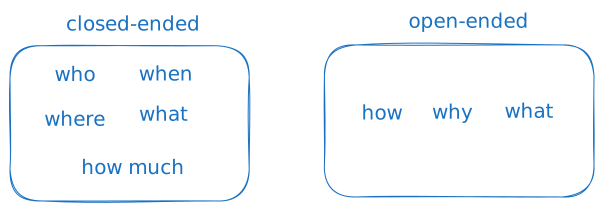
The above graph provides a bunch of words to create a closed-ended question or an open-ended question. When do we use closed-ended questions or open-ended questions? It depends on what you expect.
Asking open-ended questions takes you risks into an unknow field and you’ll find something amazing.
Be clear
You shall be clear whenever you want to be heard by others.
Organize information in structures. Introduction-points-summary structure shows your information clearly and audiences figure out the information easily. This blog just uses the structure.
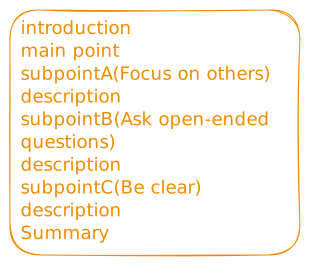
Use active voice. Active voice conveys message clearly and directly. Use active voice in the usual situations. For example, rewrite the “active voice convey message clearly and directly” in passive voice. “Message could be conveyed clearly and directly with active voice”. We can grasp the “active voice” quickly in active voice version, but need more work in the passive voice version. Sometimes, a passive voice is preferred, for example, in a situation you have to comment on someone negatively.
Summary
Focus on others, ask open-ended questions and be clear. You get it! Now start a talk with others!
Reference
[1]Debra Fine. Fine Art of Small Talk
[2]Jay Sullivan. Simply Said: Communicating Better at Work and Beyond
| Communication |
BookNotes |